Challenges of the Application of Emerging Neuroscience Technologies in Courts
-
Bakhtiary, Hassan
-
Depertment of Neurosciences, Zanjan University of Medical Sciences, Zanjan, Iran
-
Eslamitabar, Shahriar
-
Department of Health Law, Smart University of Medical Sciences (SMUMS), Tehran, Iran
-
Shirazian, Shirin
-
Department of Law, Sciences and Researches Branches of Azad University, Tehran, Iran
-
 Lame, Ehsan
Department of International Law, Najafabad Branch of Islamic Azad University, Isfahan, Iran, Tel: +98 9196255575, 9196255575; E-mail: ehsan_zaban@yahoo.com, ehsan.lame@gmail.com
Lame, Ehsan
Department of International Law, Najafabad Branch of Islamic Azad University, Isfahan, Iran, Tel: +98 9196255575, 9196255575; E-mail: ehsan_zaban@yahoo.com, ehsan.lame@gmail.com
Abstract: Significant advances in neuroscience have improved the ability of physicians to diagnose and manage neurological and psychiatric disorders in patients. The use of neuroscience evidence in criminal trials in developed countries has increased significantly in the last two decades. This rapid increase has raised questions among the legal and scientific communities about the effects that these technologies can have on judicial decision-makers. The role of neuroscience in criminal liability is a topic that has been discussed in recent years. The purpose of this article is to review the use of neuroscience evidence in the criminal justice system, as well as current research examining the effects of neuroscience evidence on judicial decision-makers in criminal cases. This review is warranted given legal and scientific concerns about the impact of potential bias. The present study was conducted and analyzed using a documentary method and with reference to research published in the last four years. Some argue that neuroscience is irrelevant in the criminal court, while others believe that it can help prove the lack of control of behavior by many criminals. However, the truth is likely somewhere in between, as certain types of neuroscience evidence may be useful and relevant in criminal trials. This article describes recent advances in neuroscience in the fields of functional neuroimaging and artificial intelligence "deep learning" algorithms, and examines the legal and ethical challenges and potential benefits and drawbacks
Introduction :
It is often said that the brain is the most complex organ in the universe 1. The capabilities of brain imaging with Artificial Intelligence (AI) are already impressive. For example, this technique can non-invasively image changes in local blood flow in the brain, the letters of the alphabet in front of a person’s eyes, and can even make very good guesses about important features of static images that a person is viewing. Beyond that, some laboratories have used these techniques to reconstruct primitive video images that a subject is watching. There is no doubt that all of this is just the beginning of brain imaging and the contribution of AI 2. A serious question is whether findings based on behavior and brain activity in a scanner are valid in real-world situations. Can a subject’s performance in a lab with a scan be a criterion for legal assessment as evidence? Can a criminal’s ability to control his impulses really affect his ability to resist criminal offenses? The science of law is about human mental states and actions, not brain states. Thus, what is the connection between neuroscience evidence and decision-making about human behavior?
The last decade has seen an increase in scholars’ interest in understanding antisocial, aggressive, and criminal behavior. In this context, there has been a nascent growth in cognitive neuroscience research, which has provided a specific understanding of the etiology of criminal behavior in the last decade, especially at the intersection of law and criminal justice 3. These advances have led to the assessment of crime, guilt, and punishment through techniques such as Electroencephalography (EEG) and functional Magnetic Resonance Imaging (fMRI) scans, which has naturally led lawyers to collect neuroscience methods and data as evidence in court. That is, brain activity is measured in the face of a specific stimulus, and this evidence is used by defendants to reduce sentences and liability 4. So, by using various technologies, including fMRI, we can look at the living brain and see which parts of it are most active. The increasing use of neuroscience evidence in criminal trials has led some to wonder what effects such evidence might have on judicial decision-makers (e.g., juries and judges) who may be unfamiliar with neuroscience 5. There are concerns that judicial decision-makers may be influenced by testimony and images of the defendant's brain. Our findings suggest that neuroscience evidence has mitigating effects on judicial decision-making, and the rationale for using neuroscience and neuropsychology in the courts is that a scientific understanding of the neural correlates of antisocial behavior will help to clarify who should be held accountable for their actions, and this will help to inform judicial decision-making. The use of neuroscience technology in court and in legal policy, however, raises two main concerns: one about the reliability and readiness of this technology to be used as evidence, and the other about the normative, ethical, and political concerns that we may have about its use 6.
In various ways the neuroscience technology is employed in criminal justice: First, whether a suspect possesses "offender knowledge" or guilty knowledge is a crucial question in the early phases of criminal proceedings (fact-finding), following the identification of the suspect. Investigating secondary sources (such the suspect's cell phone) may help draw this conclusion indirectly, but interrogative questioning is currently the only way to obtain first-hand knowledge. However, biased remarks can be introduced by interrogative inquiry, and defendants' assertions are frequently untrustworthy. Second, the likelihood of reoffending is frequently taken into consideration when deciding on a verdict for a defendant who has been proven guilty of a crime. An offender's eligibility for parole is based on their likelihood of reoffending. However, present risk assessment techniques display only poor to middling performance. Third, drugs and psychotherapy are utilized in forensic settings to manage mental health issues that can lead to aggressive conduct. However, because the likelihood of reoffending cannot be adequately decreased by the remedies currently available, people may continue to be incarcerated. These interventions are also not always effective and may have serious negative effects. Therefore, neurotechnological therapies, also known as neuro-interventions, may have wider rehabilitative uses or help lower the likelihood of reoffending 7.
Materials and Methods :
For this research, systematic literature review was conducted in order to identify various studies and researches that provide a descriptive and quantitative approach to neuroscience. Most important researches mainly books and articles were reviewed. Furthermore, to access scientific studies, several books and significant electronic online databases with the highest impact worldwide were considered as references: Scopus, Web of Science, IEEE, ScienceDirect EBSCOhost, Springer. The time period covered was from 2020 to 2024. This is due to the relevance and up-to-dateness of the information obtained during that period. Then, 52 studies were collected during the same time period, and an entry and exit screening process was performed, resulting in 17 articles remaining.
Literature review
Six interesting empirical studies in the United States (Farahani, 2015; Gaudette & Marchant, 2016), Australia (Alimardani & Chin, 2019), England and Wales (Catley & Claydon, 2015), Canada (Chandler, 2015), and the Netherlands (De Kugel & Westgest, 2015) have attempted to explore the extent to which and how neuroscience evidence is used in criminal cases.
In an analysis of US cases between 2005 and 2012, Farahani (2016) reported that 1,585 judicial opinions from criminal cases relied on neurological or genetic evidence in the defense. In 2012 alone, 250 judicial opinions argued (successfully or unsuccessfully) that criminals’ brains compelled them to commit crimes. In another analysis, Farahani found that neuroscience and genetic evidence was presented in 5% of all murder trials and 25% of all death penalty trials in 2012. In fact, 15% of the 1,585 judicial opinions reviewed specifically discussed such evidence. It should be noted, however, that only a small number of criminal cases result in convictions. Of those, only a small number go to appeals. Therefore, this collection of judicial opinions may not be representative of all cases, or even all cases that go to trial 7.
Denno examined 553 criminal cases in which neuroscience evidence was presented between 1992 and 2012, providing a different perspective on how neuroscience is used in criminal trials. Of the two-thirds (66.18%) of death penalty cases, 24.23% were cases in which a sentence of 10 years to life or more was required. In almost all cases, neuroscience evidence was presented as mitigating evidence in the defense. In only 7% of cases was evidence presented as aggravating the offense by the prosecutor. Although Denno does not ignore this issue, he reported that in all defensible cases, neuroscience evidence was often used to support a diagnosis of the cause of the crime that had been confirmed by a neurologist. Such diagnoses included substance use disorders, schizophrenia, depression, and organic brain damage (among others). However, in many cases, neuroscience evidence was used to demonstrate the presence of a "mental or behavioral" disorder that was otherwise undiagnosed. Interestingly, 63.29% of the cases reviewed specifically included some form of neuroimaging evidence, including MRI, PET, and CT scans. Today, it is possible to observe the brain in action in real time with the help of these technologies 8,9.
Neuroscience and law
Law has entered the age of neuroscience 10. Law, at its most general level, studies human behavior. Human actions are just one of the topics of the neuroscience movement. Furthermore, judicial decisions are made by human decision-makers who act and make decisions based on evidence, which is largely behavior that is reduced to neuroscience law. The process of scientific explanation of natural phenomena is becoming axioms in the human sciences, and law is not immune to this process. Neurological law is an interdisciplinary science that not only aims to re-examine the axioms of law, but also to enrich it in terms of methodology and evidence 11.
Neuroscience is invoked in connection with many different legal areas, legal concepts and theories, as well as in connection with legal decision-making. The dominant topics at the intersection of law and neuroscience arise from criminal law, health law, and legal theory and decision-making 11.
Clear statistics are hard to come by, but many indicators suggest that courts are increasingly faced with the presentation of neuroscientific evidence. Why? One reason is that many in the legal system hope that insights from neuroscience can help answer some of the hard, perennial questions that law typically grapples with. These include questions such as: Is this person responsible for their behavior? What was this person’s mental state at the time of the act? How capable was this person to act differently? What are the effects of addiction, adolescence, or advanced age on a person’s ability to control their behavior? How competent is this person? How accurate is this person’s memory? What are the effects of emotions on memory, behavior, and motivation? Is this person telling the truth? How much pain is this person in? How damaged is this person’s brain? Of course, the relevance of neuroscience to law depends entirely on the specific legal issue and context. Neurological evidence is just one type of evidence that must be weighed alongside others. But in general, neuroscience evidence may help law in a variety of (sometimes overlapping) ways, including: challenging other evidence and documentation in a case or a relevant legal assumption; identifying the existence of relevant legal facts (such as injuries, lies, or pain); separating individuals into useful categories (such as those most likely to respond to drug rehabilitation); providing new ways to achieve legal goals (such as through drug interventions that help reduce recidivism); illuminating decision-making pathways with information that may lead to more informed and less biased decisions (such as criminal verdicts for a defendant); and improving law's ability to predict likely future behavior (such as future violence) 12,13.
The brain of criminals
A very simple principle governs the way the brain works: the brain is the product of evolution, not pre-designed 14. Although criminal behavior is inherently heterogeneous and cannot be definitively limited to a specific group or origin, the common assumption in criminal offenses is that it is not moral behavior. Different areas of the human brain are the focus of emotions such as sympathy, fear, compassion, aggression, antisocial behavior, and morality, etc., so that disorders or defects in those areas are the source of crime. These traits are primarily controlled and regulated in the PreFrontal Cortex (PFC), cingulate cortex, angular gyrus, and amygdala. However, what is important in the emergence of aggressive and antisocial behavior is the under-functioning of a gene that encodes the enzyme monoamine oxidase. The regulation of this gene is important in maintaining mood states, and its deficiency leads to the emergence of a wide range of violent and antisocial behaviors 15.
Application of neuroscience evidence in criminal proceedings
In criminal trials, neuroscience evidence can be applicable and relied on in several cases, which are mentioned in this paragraph:
The first admissible evidence can be data indicating a brain abnormality obtained through a scan, and can diagnose the defendant with a condition such as a frontal lobe disorder or Traumatic Brain Injury (TBI). Currently, this evidence has a weak connection with criminal liability, because it cannot establish a causal relationship between the neurological damage and the crime. However, in rare cases, behavioral evidence may be sufficient to establish a connection between neurology and behavior, such as in cases where a brain tumor is proven to be the cause of impulsive behavior. In general, evidence of abnormality alone is usually not sufficient to prove defect or causation in criminal trials.
Second, research showing the commission of criminal behavior among people with the same disorders can help supplement the evidence regarding the defendant's brain abnormality. One study found that 73% of prisoners convicted of violent crimes had Frontal Lobe Damage (FLD), compared with only 28% of those convicted of nonviolent crimes. However, this study only suggests that a high proportion of violent individuals have this brain abnormality and does not necessarily mean that individuals with this abnormality are violent.
Third, genetic and environmental factors that make individuals highly susceptible to committing serious crimes may be considered by criminal courts. However, even if there is compelling evidence that a crime was caused by a neurological abnormality, evidence of planning by the defendant or other factors can still undermine the defense. Planning can be defined as the process by which humans’ program themselves in response to experiences, which is the basis of neural computation 16.
Fourth, neuropsychological testing provides insight into a specific defendant’s functioning, including his or her ability to exercise self-control, ability to plan and act on intentions, and awareness of risks. However, this testing provides limited insight into a specific defendant’s functioning rather than providing the type of functioning that might be associated with a specific brain abnormality. There are several obstacles to this approach, such as misuse, difficulty in obtaining baseline data for relevant demographic groups, and the fact that test results do not necessarily reflect the defendant’s mental state at the time of the crime. Furthermore, science itself cannot provide a definitive answer to a normative question of how much "impairment" is required for legal purposes.
Finally, neuroscience findings can be used to compare the brain structure and function of defendants with those of juveniles or people with intellectual disabilities, which can be taken into account in sentencing. The U.S. Supreme Court has exempted the mentally disabled and juveniles from the death penalty, stating that they are less culpable than ordinary criminals. This approach is known as the "scientific precedent rule". However, identifying the neural features that should be used for comparison remains a scientific and legal challenge 13,17,18.
Judicial decision-making
Neurolaw seeks to facilitate the improvement of legal and judicial laws and regulations by utilizing the results of scientific research in the field of the brain and neuroscience. For example, it may be investigated the role of neurological disorders in criminal behavior or how neurological treatments can affect criminal behavior and offenses 19. In the fair implementation of the legal system, more important issues are involved in the decision-making of juries and judges, who can help to make impartial decisions in the cases before them. Until recently, there was no way to know-as an important part of a study of the nature of legal decision-making - how the human brain decides who has committed a crime, and-in such cases-on what basis the person should be punished. In a study by the Working Group of the Research Network on Purpose and Punishment, they clarified the extent of punishment by considering the fMRI image of the brain and the neural processes underlying these decisions. In this study, which used fMRI brain scans, while subjects were tasked with making decisions about liability and punishment (for criminals in hypothetical scenarios), the researchers identified distinct brain activity that was separately as-sociated with four key components of those decisions:
1) assessing harms, 2) recognizing mental states in others, 3) integrating these two pieces of information, and 4) determining the amount of punishment.
New questions therefore arose:
Is the brain activity associated with different outcomes distinct enough for a machine learning algorithm to correctly classify the outcome of a decision based on brain data alone? How do brain regions interact when we consider mitigating factors on the one hand and aggravating factors on the other? 13-20.
The neural basis of legal decision making
In the past, brain activity was modeled using a spatial approach to brain centers, which assigned specific functions to separate neuronal regions. Later, the integrative approach to spatial function argued against the functional, non-spatial approach of spatial and functional connectivity across large cortical regions 21.
Although much of the interest in neuroscience has focused on understanding the minds and brains of criminals, neuroscience can also make important contributions to the judicial decision-making of judges. A fair and impartial legal system relies on impartial judgment as they decide the guilt of defendants and impose appropriate sentences. Despite the high stakes, judicial decision-making is subject to the same influences and extreme perspectives as other decision-making processes. For example, the issue of racial bias has plagued the judicial system from racial profiling to appellate court decisions (such as the recent George Zimmerman case [1]) 22. It seems clear that developing a broader and deeper understanding of the neural mechanisms of judicial decisions may ultimately contribute to efforts to improve the fairness and effectiveness of the criminal justice system.
Fortunately, neuroscience-based judicial decision-making can benefit from the neural underpinnings of decision-making 23. Even more relevant, research into the neural mechanisms underlying punishment of others (I am punishing you for harming me) 18 is where judicial decision-making overlaps significantly with moral neuroscience 24.
Case studies
Neuroscience technology has had a mixed impact on criminal courts. Brain scans have been offered to reduce the sentence of a defendant, to show that a defendant is unfit to stand trial, and to prove that the defendant was not conscious at the time of the crime, although the scans are not universally accepted or successful. Sometimes the scans merely show evidence, not causation. For example, in People v. Goldstein [2], the defendant who pushed a woman in front of a subway train and killed her offered a PET scan that showed brain abnormalities in an attempt to prove that he had schizophrenia. While the prosecution acknowledged that Goldstein suffered from schizophrenia, the court excluded the PET scan as evidence because, although it indicated a brain abnormality, it was not actually evidence of the mental element of the crime, "because a diagnosis of schizophrenia does not in itself prevent a defendant from at least being capable of understanding the nature of such a crime". Cases such as these demonstrate that, at least in the United States, neuroscience data can be useful as a means of evidence, although the court may reject the data as admissible if it fails to establish a causal basis for the defendant’s actions or if it is not accompanied by credible evidence.
Neuroscience evidence has also been used in various juvenile justice cases. In Miller v. Alabama [3], the U.S. Supreme Court cited findings from brain science about impulse control, planning, and risk aversion to strike down as unconstitutional the imposition of life sentences without parole for juvenile offenders. This case, and at least twenty others, relied on an affidavit written by national PET expert Reuben Gore, who argued that juveniles are not as capable of controlling their impulses as adults because the development of neurons in the prefrontal cortex is not complete until the early twenties. In a similar case, in Graham v. Florida, the Supreme Court relied on neuropsychological and psychological data about juvenile development when it sentenced juveniles to life without parole for non-murder offenses under the Eighth and Fourteenth Amendments. Courts have also considered neuroscience evidence in civil cases. In his dissent in Brown v. Entertainment Merchants Association, Justice Breyer cited advanced neuroscience to support the argument that violent video games are linked to aggressive behavior. In other cases, neuroscience evidence has been successful in proving mental incapacity. For example, in Brown v. Entertainment Merchants Association, the defendant presented a brain scan to prove his mental incapacity, which led the court to invalidate a real estate contract he had signed [4].
The fundamental challenges of neuroscience versus law
Most neuroscience findings, in addition to philosophical, psychological, and other related scientific approaches, are largely based on neuro-medical technology experiments. Coronary arteries are mostly based on the cognitive study of the brain through brain imaging. In this way, neuroscientists extract neural data and relate them perfectly to legal effects. Brain scans are used to prove civil or criminal liability against the plaintiff. Based on hermeneutic interpretation and different perceptions of behavior, the problem here is the interpretation of neuroscience data and neural images 25.
Proofing a claim in court must be precise, logical, and documented. Therefore, the real problem that arises is the probable or almost certain neurological inferences that neuroscientists try to present as legal evidence; which is the main problem of the court; as a result, a situation arises in which the impact of cognitive neuroscience on the legal field will be very complex and difficult 26.
In addition to the above, there is a major challenge between neuroscience and human rights. Neuroscientists are trying to access neuroscience data from brain scans (such as MRI, fMRI, and EEG), while human rights advocates are preventing them. Typically, such a conflict occurs with claims of the right to privacy or perhaps the right to health; just as conflicting norms arise between medical rules and medical testing requirements. All of this makes us focus more on neuroscience and law to find a solution and a suitable direction between their propositions; this helps neuroscience rules and principles to contribute to both the legal and neuroscientific understanding of human behavior. We know firsthand:
1- "Better legal outcomes bring better clinical outcomes for patients with neurological damage; 2- Success in neuro-lifting depends largely on the quality and quantity of expert evidence; 3- Mutual cooperation between relevant professionals increases the likelihood of neuro-lifting success; 4- To be successful, clinical and legal professionals need legal literacy" 25.
A definitive neurological diagnosis is critical in all cases. Neuroimaging findings in the absence of an established neurological diagnosis carry a high risk of false-positive findings and should be interpreted with great caution. For example, subjective interpretations of enlarged ventricles or small hypertensions on MRI are nonspecific and can occur even in normal individuals without neurological diseases. Such findings should not be used to argue for neurological impairment in an individual without a clear neurological diagnosis related to these findings. Conversely, neuroimaging may be a false-negative result in a subject with an excellent neurological diagnosis but without the neuroimaging features present. For example, early BvFTD patients may have relatively normal functioning on neuropsychiatric tests, but neuroimaging abnormalities help support the conclusion that the behavioral changes are associated with a neurological disorder. Next, forensic evidence must determine whether a neurological disorder contributes to the behavioral changes in a particular subject. This raises important concerns about causality. For example, the incidence of mild brain injury or concussion is high and may even be higher in the population of offenders or defendants. However, this does not necessarily mean that a diagnosis of TBI has contributed to the behavioral changes 25.
Conclusion :
Advances in cognitive neuroscience effectively guarantee a future in which the law increasingly engages with neuroscience evidence. Even at this relatively early stage, there is a gradual but discernible shift from an almost exclusive reliance on structural brain evidence (in cases involving any brain evidence) to an increasing reliance on functional neuroimaging. As this shift expands and accelerates, there will be differing views on whether and when to use different types of neuroimaging data to inform legal decisions.
Scientific methods and social norms are constantly changing. And it is possible that such perspectives, discourses, guidelines, and international laws will need to be explored and interacted with it and as brain science advances, and proposed for use in legal processes. Perhaps then the integrated approach should not only include a scientific and ethical effort, but also a focal orientation toward defined applications in the courts in order to "explicitly direct and align the capabilities of brain science with the purposes and limitations of the law". For while justice may be blind, it must be vigilant, to ensure that new technology does not circumvent the provisions of the law, and that the law does not misinterpret the capabilities and/or limitations of technology.
Thus, the usefulness of neuroscience in criminal trials or sentencing under current law is limited and likely to be significant only in cases of cognitive or volitional impairment. Even in capital cases, the usefulness of neuroscience may be uncertain, although defense attorneys may still use such data as evidence. There are several controversial discourses among neuroscientists (mainly related to mind reading) that remain unresolved. On the other hand, inspired by such controversial discourses, some legal norms are significantly exposed to argumentative interpretations in addition to moral constraints. Then, theoretical constraints can be divided into discursive and normative questions.
Conflict of Interest :
Authors declare no conflict of interest.
Funding: This study has no funding support.
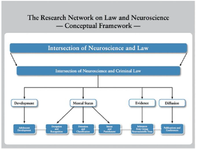
Conceptual Framework of the MacArthur Foundation Research Net- work on Law and Neuroscience Taken from (www.lawneuro.org).
|
|